Green light for City Region Deal commercial project in Kirkcaldy

Fife’s flagship Industrial Innovation Investment programme has secured planning permission for seven single storey business units within Dunnikier Business Park in Kirkcaldy. 

Work on land to the east of Midfield Drive is scheduled to begin this autumn.

The programme is part of the £1.3 billion Edinburgh and South East Scotland City Region Deal, a partnership of local authorities, universities, Scottish and UK governments to deliver a 15-year programme that will transform the regional economy.

The construction will include solar panels and a new access road as well as car parking.

This will boost economic development opportunities within Kirkcaldy, and provide small business space to local enterprises with growth ambitions.

The Fife Industrial Innovation Investment programme will deliver new buildings and serviced sites across Mid and South Fife. It will support the creation of 1,000 new skilled permanent jobs and almost 600 short-term construction jobs. This will be facilitated by joint working between the region’s universities and Fife businesses and Fife Council to deliver high value jobs.

Neil Crooks, convener of Fife Council’s Kirkcaldy area committee, said: “This is a major economic opportunity for the businesses that will be able to expand into the new units. We know that demand in Kirkcaldy is strong for this type of Unit, so the emphasis is very much on getting these ready for tenants as quickly as possible.

“Our focus in Fife is firmly on fairer economic growth, where everyone benefits from good employment opportunities and regional investments. The programme of investment will deliver much-needed new industrial buildings in key locations in Mid and South Fife.

“This is another important step forward in delivering the ten-year programme that will encourage more businesses to locate and grow within Fife, and secure a further £30m of investment by the private sector.”

Altany Craik, convener - economy, tourism, strategic planning & transportation committee at Fife Council, added: “This project, now on its way to becoming a reality, will be the first visible sign in Kirkcaldy of the positive changes that the City Region Deal will bring to Fife.

“Through the Edinburgh and South East Scotland City Region Deal regional partners will secure more than £1.3 billion of investment for the city region over the next 15 years.  We believe that this can create clear opportunities for genuine inclusive economic growth and investment in Fife. 

“The Deal focuses on growing the regional economy through collaboration and by being outward-looking, building on the region’s existing strengths in key sectors and industries. Our Fife Industrial Innovation Investment programme will increase the supply of serviced employment land and new industrial, office and business space in Fife.”

Cabinet secretary for transport, infrastructure and connectivity, Michael Matheson, said:“Since 2014 we have committed £1.8 billion through these deals and associated investment to help drive growth that will deliver significant and lasting economic benefits for individuals, businesses and communities across our country.

“These deals benefit Scotland as a whole and have the power to build on an area’s significant strengths and expertise. Fife’s flagship industrial innovation investment programme is a perfect example of this and I’m delighted to see it progressing.”

The Fife Industrial Innovation Investment programme will be delivered in three phases. Over the next two years, new industrial premises will be developed across four sites in Glenrothes, Kirkcaldy, Lochgelly and Dunfermline.

Over two hectares of new serviced employment land in Dunfermline and Dalgety Bay will also be made available for immediate investment by new or existing businesses. 

In consideration of the application for planning permission, the proposal to erect the business units and associated work within the existing Dunnikier Business Park was assessed against the Development Plan alongside other considerations, including the principle of development, transportation, urban design and the demand for quality, modern units.

City Region Deal launches Covid-19 Job Support

A Job matching service has launched today for the Edinburgh and South East Scotland City Region, in response to the COVID-19 outbreak.

The COVID-19 Job Support website will match live vacancies with job seekers who have registered for alerts. Information and support advice for employers, employees and jobseekers will also be available.

The City Region Deal partnership had been developing a job matching website, but fast-tracked the plans in response to the pandemic.

East Lothian Cllr Norman Hampshire, Chair of the City Region Deal’s Joint Committee, said: “We’re committed to using our collective strengths and resources to help the region recover and respond to the huge challenge that COVID-19 has created. The job support website marks the first of what I hope will be more initiatives that our City Region Deal network can quickly mobilise to help employees and job-seekers in the coming months.”

There are immediate job opportunities across the City Region in essential and sudden-growth sectors, including the NHS, supermarkets, home deliveries, take-away food and beverages.

Steve Grimmond, Chief Executive of Fife Council and Chair of the City Region Deal’s Skills and Employability group, commented: “Thanks to the agility and dedication of all our partners, I’m delighted we were able to fast-track the job matching service to help mitigate the impact of COVID-19 on the City Region’s workforce. I hope the online portal helps meet the urgent needs of both employers and at-risk employees, as well as existing job-seekers.”

The re-purposed site – developed free of charge by Hanlon Software Solutions - will also help capture the scale of the jobs challenge through data collection from those who register. 

Cabinet Secretary for Transport, Infrastructure and Connectivity Michael Matheson said:

“City Region Deals are designed to bring people together to work in partnership and this is a great example of the benefits that can come from those new relationships.

“This initiative will create new connections helping link those seeking work to employers in our vital services ensuring they have the resources required.

“I would like to thank those involved for their quick action and initiative. We would encourage partners in all city regions to look at what they can do to support their local economy and communities through these challenging times.”

The website is available at: www.c19jobs.org

For further information, email: c19jobs@capitalcitypartnership.org

Academic profile: Sarah Galey-Horn

Sarah Galey-Horn is a Post Doctoral Research Fellow in the University of Edinburgh’s Moray House School of Education, whose specialist area of research is family social capital and network interventions. The City Region Deal recently spoke to Sarah about how she’s helping to evaluate the Deal’s intensive family support proposals.

Sarah Galey-Horn, University of Edinburgh

Sarah Galey-Horn, University of Edinburgh

How did you get involved with the City Region Deal’s intensive family support work?

I heard about the Train@Ed fellowships and was interested in the opportunity to work in a non-academic setting. After looking into different areas of activity in the City Region Deal, I recognised the intensive family support (IFS) work would be an ideal area to get involved.

I wrote a Train@Ed application based on helping to evaluate the IFS proposals. I have prior experience in network interventions in real-life setting from when I lived in the US, and the City Region Deal IFS project has offered a chance to expand that part of my professional repertoire.

Through this, I’m hoping to build on my previous research in social data use, which is also called ‘network intervention’, within the context of a significant policy intervention. Through colleagues at the University of Edinburgh - who were already involved with the City Region Deal - I contacted the IFS project lead Adam Dunkerley, from Fife Council, and have worked with the team closely since the beginning on the IFS proposal.

How did you become involved in this field of research?

I came to the fellowship from the educational field.  I started as a high school teacher, which I did for five years before going back to school to get my PhD in education policy. In my programme at Michigan State University (MSU) I was fortunate enough to learn from and work with a leading social network scholar, Dr Kenneth Frank, who was also one of my doctoral advisors.

Dr Frank introduced me to network intervention concepts through a lot of his own work. I ended up working on some of his network intervention projects, and not all of them were in education. This gave me a lot of practical experience applying network concepts in policy interventions. It also helped me to learn how to do research outside of my specialisation and work with people from outside of academia.

 Can you provide an overview of the IFS work?

In social and education policy, policy makers tend to focus on individual attributes and measurements, but the problem with that is a lot of the outcomes we are concerned with are the product of complex social phenomenon.

Relationships with other people, are one example. But how do you measure the impact of a relationship? While analysing social networks, which is a widely used method in social science research, is one way. This project uses social network analysis to better understand the influence of relationships on extreme poverty and deprivation in families.

Social networks, such as family relationships, but also workplace relationships and friend circles, are important predictors of individual behaviour because they are conduits for social capital, which are non-material resources. Positive social interactions with others, for example, provide individuals with a sense of meaning, purpose and dignity and provide a barrier against feelings of isolation and rejection associated with economic deprivation. Yet these kinds of social factors are usually not considered by policymakers or programme evaluators when crafting and assessing social programmes; partly, because there has been no way to capture and track social capital empirically.

In part, the IFS programme is about changing that. We want to show how social capital impacts progression for those citizens facing extreme poverty or deprivation and, therefore, that it is a key ingredient for understanding the effectiveness of social policy interventions.

The IFS project is due to start in April 2020, and I’ve been working closely with the lead delivery agency, Capital City Partnership, on how to integrate social network data use. Social network data use has been written into the specifications of the IFS business case.

I’m also working with colleagues at Capital City Partnership and organisations who’ll be delivering the IFS services, helping develop implementation guidelines and training activities. In the longer-term, we are hoping to get funding to develop software for social network data use.

We’re trying to assess the existing IFS measures across the six local authority areas within the City Region Deal, and how we can help to build on that. There will be a period of data collection of about one year before moving on to an initial evaluation of social effects within the IFS programme. We also want to train the relevant service delivery teams in collecting and making use of that data.

What will be the main outcomes?

As far as research goes, the main outcome will be an analysis on the effects of social capital on IFS intervention outcomes. For policymakers, this will provide evidence to support the use of social network analysis to understand the effects of the IFS programme. And I also plan to publish in academic circles as well.

There are practical outcomes are probable but more important and interesting. Mainly that means developing network intervention tools to support service delivery. And that is both at the organisational level and the service delivery level. At the organisational level, we are developing network visualisation techniques to help partners understand how community assets and professional interactions support the IFS programme implementation. Then we want to be able to help IFS use that data to build more supportive and effective networks.

At the practice level, I hope that innovation in practice will be one of the outcomes of increased use of social network data. Social network analysis offers a great model for the study of the diffusion of innovation; how does innovation travel through organisations, why do some people adopt innovation and others not? I want to capture the fact that social workers will be innovating and problem-solving – perhaps not in the traditional technological sense. But innovation can take place in a very practical way in ordinary workplace environments, addressing real-world problems. It’s important to understand small innovations in practice that make a big difference can exist at a micro and localised level – but they can be genius.

This has been a great learning experience for me to find out more about the front-end delivery of social services. Because my previous research has been based on the study of policy interventions, the IFS work has helped me realise the importance of consulting with those at the front-end of delivering services.

Have you ever worked on research for projects within the region where you live before?

This feels like a natural progression for me personally and connects two important areas of my life; my community work for the area I live in and my professional life.

How would you like to develop the work in future?

Further down the road, we want to apply for grant money to scale up our work. If successful in achieving funding for software development, this could be used by social care workers and others. I’m also aiming to develop a series of professional development modules in social network data use. At the end of the process, we hope to have new capabilities to collect this type of data and build a database on social networks. The goal is to have funding secured and modules launched within a year or two of the IFS formally starting.

Fife businesses set to benefit from pioneering Data-Driven Innovation programme

L to R: Jarmo Eskelinen, Director of the Data-Driven Innovation (DDI) initiative and Gordon Mole, Head of Service- Business and Employability, Fife Council

L to R: Jarmo Eskelinen, Director of the Data-Driven Innovation (DDI) initiative and Gordon Mole, Head of Service- Business and Employability, Fife Council

Tackling business challenges and opportunities through Data-Driven Innovation 

Fife businesses have started on a journey that will enable them to reap the vast benefits of the Edinburgh and South East Scotland City Region Deal Data-Driven Innovation (DDI) programme that is set to boost economic growth. Business leaders and managers from across Fife recently attended an industry event on how best to drive improvement through data on 26 February, at the Double Tree by Hilton Hotel, Inverkeithing.

Delegates were given new insights into how data can expand the contribution of research to the region’s economy, and increase entrepreneurial activity. Fife businesses were also shown how companies are already using data technologies to enhance commercial performance and the profound impact data innovation is making across diverse sectors.

Jarmo Eskelinen, Director of the Data-Driven Innovation (DDI) initiative, shared his experience of working with businesses, universities and city leaders in the UK and Finland to drive improvement and tackle their growth challenges with data.

The 15- year £661m Data-Driven Innovation programme is a key part of the City Region Deal, and is designed to reach out to the whole City Region, so that businesses, public sector bodies and other organisations can use data to improve productivity and develop new products and services.

The University of Edinburgh is collaborating with Heriot-Watt University to create five DDI ‘hubs’ targeting 10 industry sectors across the public, private and third sectors - from creative industries and healthcare to fintech and robotics. The ambitious programme is designed transform the city region into the Data Capital of Europe through better data skills. It aims to train 100,000 people in data skills over the next decade, from computer science specialists to traditional jobs that will increasingly use data.

Gordon Mole, Head of Service- Business and Employability, Fife Council, said: "We are starting to explore the potential for Data Driven Innovation to improve our region’s economy by creating more and better jobs, improving services, while helping some companies to start-up and others to grow.

"This ground-breaking City Region Deal Data-Driven Innovation initiative is enabling a diverse range of organisations to develop and test new services to meet the needs of our communities.

"A number of businesses looked into how data can ensure continuous improvement in your business, and drive economic growth, social change and public services."

Jarmo Eskelinen, Director of the Data-Driven Innovation (DDI) initiative, said: “The DDI Programme is committed to supporting local businesses as they experiment and embed data driven innovation into their business processes. This pilot project will allow Fife Council and the University of Edinburgh to support the input of cutting-edge research and expertise into Fife-based businesses, through a new integrated approach to innovation funding support. There is already interest from other City Region local authority partners to trial the approach if this pilot is successful.”

Through this, and other events, the City Region Deal will ensure that organisations from across the region fully benefit from the fast-developing field of Data-Driven Innovation and drive innovation through big data and artificial intelligence.

It is estimated that Scotland needs around 13,000 extra workers each year with data skills as the workplace transforms. Together, the two universities will increase the provision of data science teaching for their students, and support schools and colleges across the region to provide digital skills teaching and training. The region’s supercomputing capabilities will also be strengthened with investment in a data analysis facility, which will help 1,000 organisations use data to innovate.

Companies attending the event included CoorsTek Ltd, Diageo, FLEXCon, Subsea International Ltd, Scott Group, Interface and Scottish Manufacturing Advisory Service (SMAS).

Work starts on Fife’s flagship City Region Deal programme

Fife’s flagship Industrial Innovation Investment programme is now taking shape as construction work starts on nine new business units at Queensway Industrial Estate, Glenrothes. 

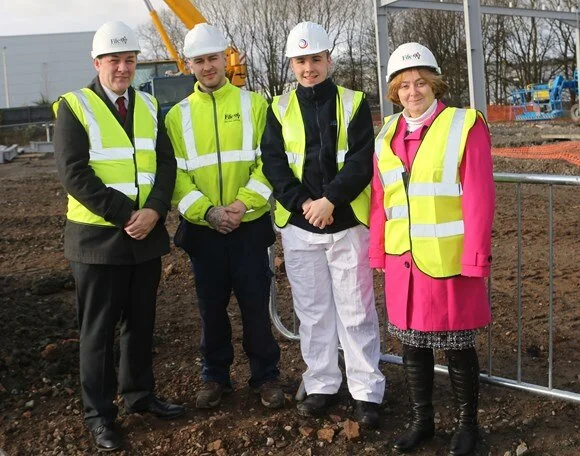
L to R: Cllr Altany Craik, Fife Council Modern Apprentice, Matthew Fleming, Bell Group Modern Apprentice, Michael McManus, Cllr Fiona Grant.

L to R: Cllr Altany Craik, Fife Council Modern Apprentice, Matthew Fleming, Bell Group Modern Apprentice, Michael McManus, Cllr Fiona Grant.

Fife’s ten-year £48.4m Industrial Innovation Investment Programme will deliver much-needed new buildings and serviced sites in key locations in Mid and South Fife. It will create 1,000 new skilled permanent jobs and almost 600 short-term construction jobs over the 15-year lifetime of the City Deal. Joint working between the region’s universities, Fife businesses and Fife Council will deliver high value jobs.

The programme forms part of the Edinburgh and South East Scotland City Region Deal, a partnership of the Scottish and UK Governments, local authorities and universities that will transform the regional economy. Through the Edinburgh and South East Scotland City Region Deal, regional partners will secure more than £1.3 billion of investment for the city region over the next 15 years. 

The programme is already boosting the economy through construction activity.

Infrastructure Secretary, MSP Michael Matheson, said: “Since 2014 we have committed £1.8 billion to deals and associated investment to drive growth that will deliver significant and lasting economic benefits for individuals, businesses and communities across the country.

 “These deals benefit Scotland as a whole, creating thousands of jobs and upskilling local labour markets. They truly have the power to build on the area’s significant strengths and expertise, as we are witnessing first-hand in Fife with the start of this flagship industrial innovation investment programme.”

The City Region Deal is ensuring skilled local jobs for local people.  Michael McManus, aged 19, from Glenrothes, who is in his first year of a Modern Apprenticeship, with Bell Group, Kirkcaldy, is set to work on the site.

The Bell Group, Kirkcaldy, is a branch of UK's largest commercial painting and decorating contractor. Michael said: “Through my apprenticeship I have been able to work on, and improve, my painting and decorating skills. I’m confident in my role and I've learnt new skills. In the future I’ll continue to improve to be the best painter and decorator I can possibly be.”

Fife Council Modern Apprentice Matthew Fleming, age 25, from Leven, will be involved in fitting the plumbing inside the nine units. Matthew will fit the mechanical plumbing fixtures and fittings. Now in his fourth year of his Modern Apprenticeship, Matthew has developed skills in plumbing installations and maintenance, installing and servicing gas appliances, as well as bathroom repairs and replacements.

Cllr. Fiona Grant, Convener, Glenrothes Area Committee, said: "The units are a huge step forward in offering businesses accommodation fit for the future and will help will boost economic development across Mid Fife. The development includes a connection to the district heating plant, a new access road and car parking on land to the north of Flemington Road."

Cllr. Altany Craik, Convener, Economy, Tourism, Planning & Transportation Committee, said: “Our focus in Fife is firmly on fairer economic growth, where everyone benefits from good employment opportunities and regional investments. Work starting in Glenrothes is the first visible sign of the many positive changes that the City Region Deal will bring.

 “The Deal is set to help grow the regional economy through collaboration and building on the region’s existing strengths in key sectors and industries.

"Through the wider City Region Deal Fife businesses will have increased opportunities to build-on the value they generate from their data by adopting digital technologies, and use this to create new products, and generate both new supply chain arrangements and new business models - creating and safeguarding jobs."

Fife's Industrial Innovation Investment programme will increase the supply of serviced employment land and new industrial, office and business space in Fife. This is an important step forward in delivering the programme that will encourage more businesses to locate and grow within Fife, and secure a further £30m of investment by the private sector.